What Kind of Traditional Art Did the Mikmaq Make?
Mi'kmaq Quillwork on Birch Bawl
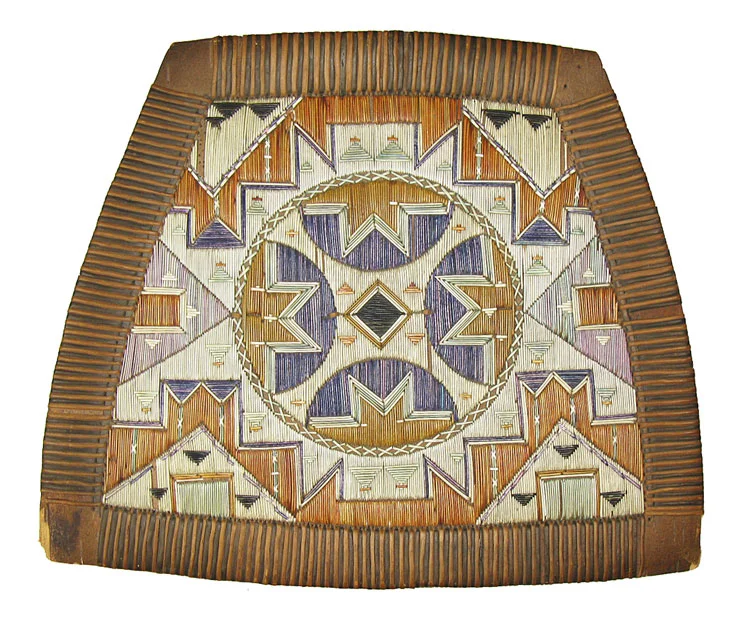
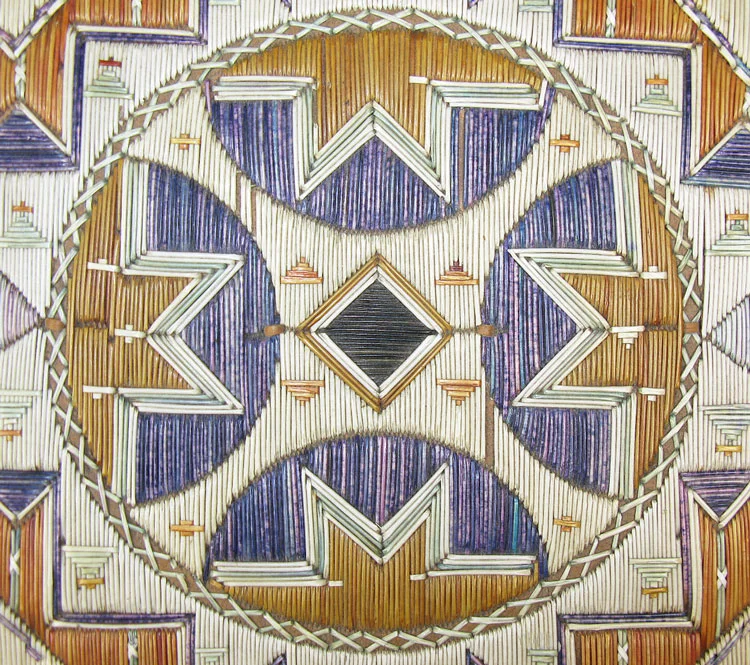
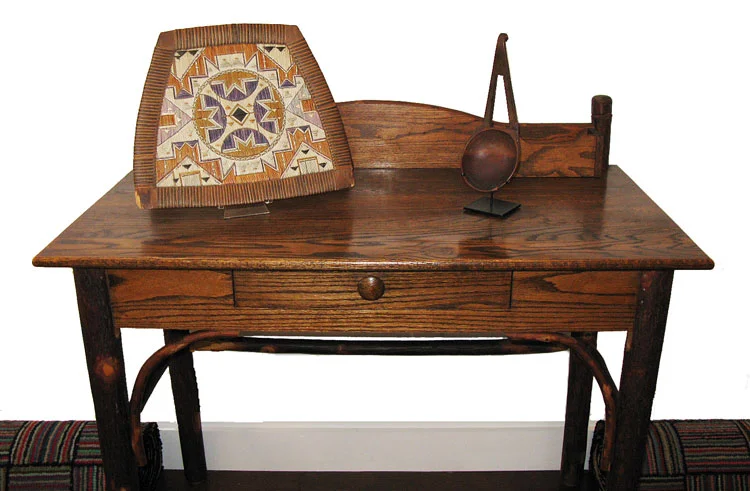
This saddle-shaped birch bawl panel is elaborately decorated with geometric designs fashioned from dyed porcupine quills. Information technology is a stunning example of traditional Mi'kmaq Indian quillwork dating from circa 1850-lx, and has the provenance of by ownership by a distinguished British collector of tribal art. That this graphic artwork was fashioned as a seat for a formal Victorian chair, and that it concluded upwards in the easily of a European, both brand perfect sense in light of the history of how this Native Northward American Indian craft evolved.
A Bit of History
Mi'kmaq in the Nova Scotia region of Canada have used dyed porcupine quills equally decorative ornamentation for hundreds of years, practicing this art long before their contact with Europeans. Explorers and fishermen who first encountered Mi'kmaq recorded observations of decorative quillwork, such as in this sailor's account written in 1606: "…the maids and women do make matachias (bracelets) with the quills or bristles of the porcupine, which they dye black, white and red colours, every bit lively as possible may be." (Whitehead, 1982)*
Given that in that location are 20,000-30,000 quills on a single porcupine (yes, somebody counted them), they were an abundant source of raw material for handicrafts.
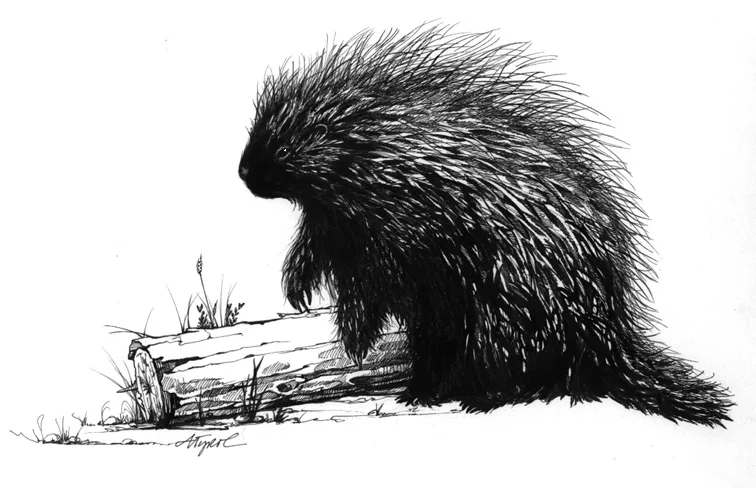
Illustration by Adelaide Tyrol (northernwoodlands.org)
Not long after white people started living and trading among them, Mi'kmaq people turned their adroitness skills to making objects to sell to Europeans. They had traditionally used techniques such as stitchery, loom weaving, wrapping and plaiting of porcupine quills to decorate objects for their own use. They also decorated their birch bark canoes with porcupine quills, and then inserting quills into birch bark to make decorative designs was another technique within their traditional repertoire. By the mid-1700s, when the souvenir manufacture was in full swing, the bark insertion technique had get the Mi'kmaq'due south dominant form of quill ornament.
Birch bawl boxes busy with geometric mosaics of dyed porcupine quills were a staple of the Mi'kmaq'southward merchandise with French and English settlers. European entrepreneurs began buying up these crafts, and ships' captains would resell them at their ports of call. By the early 1800s, the sale of quillwork and other Indian crafts in Great Britain had become lucrative enough that their importation was taxed by the British government.
As the fur trade declined throughout the early 19th century, quill work became a primary source of Mi'kmaq's income. This explains their motivation to adapt rapidly to European tastes, which during the Victorian era included fancifying even everyday household items such equally tea cozies, direct-border razor cases, comb boxes and napkin rings.
Sometime around 1840, a European fad for article of furniture inset with panels of quilled birch bark emerged. Mi'kmaq women began to add chair bottoms fabricated of birch bark ornamented with dyed porcupine quills to their wares. In 1851, the Nova Scotia Industrial Exhibition offered a prize for "the best quill work chair bottoms."
Solitary chair seats were produced for years prior to the production of matching sets of chair seats and chair backs, which helps united states of america appointment our lone chair seat to the earlier product timeframe of the mid-1800s. Single quilled chair bottoms sold for $2-$five to homeowners and merchants, besides as straight to the cabinetmakers who mounted them on manus-crafted chairs.
The chairs into which quilled panels were inserted were fashioned in styles pop amongst Europeans of the time. Several years ago, nosotros sold a formal hall chair that had both a quilled back and a quilled seat to an American museum. That chair (pictured below), had been purchased by James Du Pres, third Earl of Caledon, on a trip to Nova Scotia during the 1800s – an example of the vibrant merchandise that existed betwixt the Mi'kmaq and enthusiastic British collectors.

Features of the Quilled Chair Seat
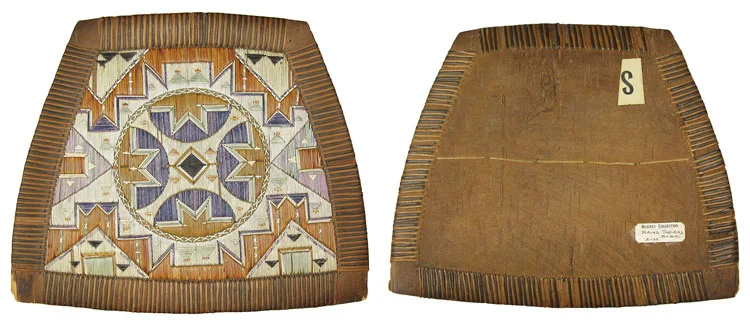
This chair seat (xiii" x fifteen.five") is made in the traditional manner from two sandwiched pieces of birch bark – a decorated pinnacle piece and a plainly piece equally backing. The pattern incorporates a variety of geometric forms, including halved star-similar patterns which in their entirety form what the Mi'kmaqs chosen eight-legged starfish.
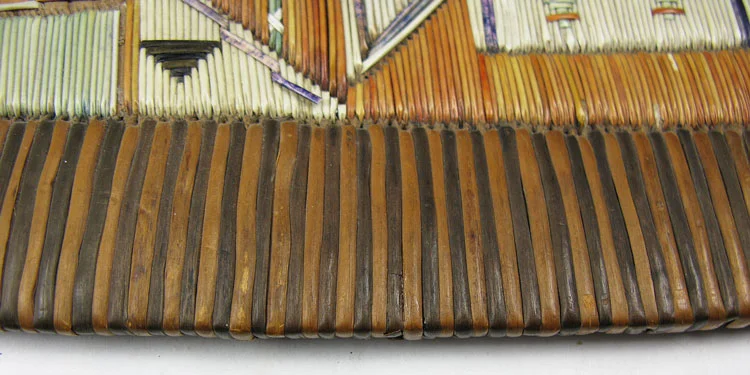
This seat has an especially squeamish edge treatment, being lashed with split Black Bandbox root in alternating dyed blackness and natural dark-brown colors. Mi'kmaq used similar bandbox root lashing across the inner and outer gunwales of their birch bark canoes, but it was an uncommon treatment for chair seats.
The corners of the panel are undecorated, perhaps so that the seat could be attached to a chair frame in those spots. Although in that location are small tack holes in iii of the corners, they do not go through to the dorsum console, and then this seat was most likely never used on a chair. The excellent colour retention and good condition of the quillwork (there are only v-vi missing strands) are further evidence that this chair seat was non used for its intended purpose.
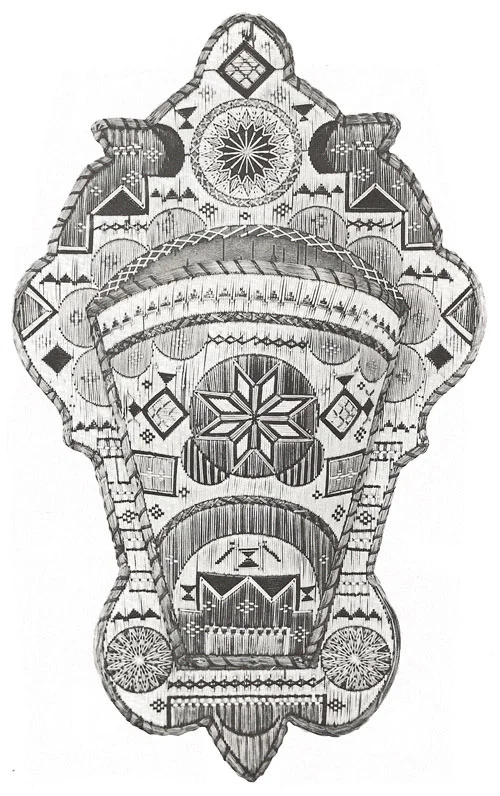
The quillwork color scheme is very like to that of a Mi'kmaq birch bark box (below) that was decorated around 1810 in quills colored with organic dyes - Bloodroot for the golden brown, Logwood for the lavender blue, and Goldthread for xanthous.

In pre-contact eras Mi'kmaqs extracted natural substances from plants, minerals, insects and shellfish to brand their own dyes, just by the time this box was made in 1810 they were able to obtain natural dyes from European settlers through purchase or trade. Beginning in 1856, Mi'kmaqs would also have been able to obtain newly discovered synthetic aniline dyes. The brighter blue/regal quills in the middle of our chair seat may have been colored with an aniline dye, as Mi'kmaqs used both natural and synthetic dyes for quills during the third quarter of the 20th century, until transitioning entirely to commercial dyes past the 1890s.
For fine quillwork on bark items such as this chair seat, Mi'kmaq women extracted the longer (upwards to 5") and thinner hollow quills from the nape of the porcupine's cervix down to the base of operations of its tail.
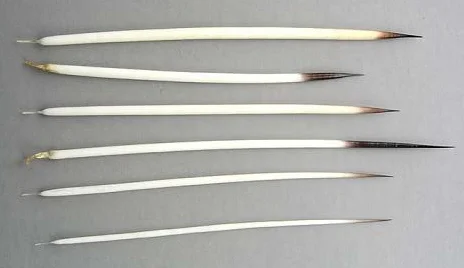
North American Porcupine quills are white with black tips that are covered with fine black barbs.
Before scratching or using a compass to etch a design on birch bark, the bawl was warmed slightly by a fire or with warm h2o. Both the bark and the dyed quills were worked while damp, with the quills moistened one at a time as they were used. The artisan used an awl or darning needle to make an insertion hole for the base of a quill, and then another pigsty where the barbed stop was inserted until the entire darker tip was hidden within the hole rather than visible in the design. The extra quill length was and then cut off from the dorsum. As the bark stale and shrank and the moistened quill barbs swelled inside the pocket-size holes, each quill became held tightly in place.
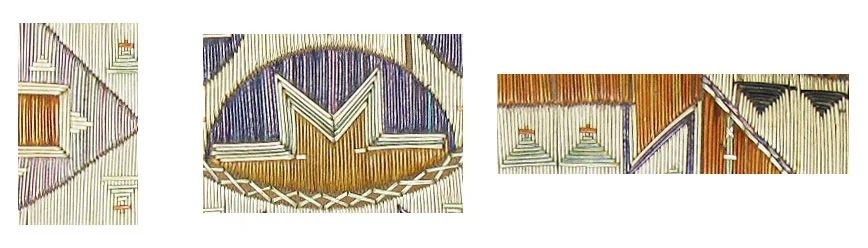
This chair seat incorporates iii techniques of bark insertion quillwork. The mosaic technique in which quills are laid side by side creates the primary pattern, with well-nigh of the quills laid vertically. The make full technique, which was used to fill up transition areas betwixt segments of the design, is evident in the cross-hatch stitches around the primal medallion and in concatenation stitches along borders between different geometric shapes. Finally, the overlay technique is present every bit small triangles worked over areas that were already solidly quilled behind them.
From a By to a Present Collection
In addition to the appeal of its colorfully graphic artwork, this chair seat has additional importance because of its provenance. It was in one case in the collection of Harry Geoffrey Beasley (1881-1939), an English language aristocrat who together with his wife Irene Marguerite Beasley amassed and meticulously documented a huge collection of tribal art over his lifetime.
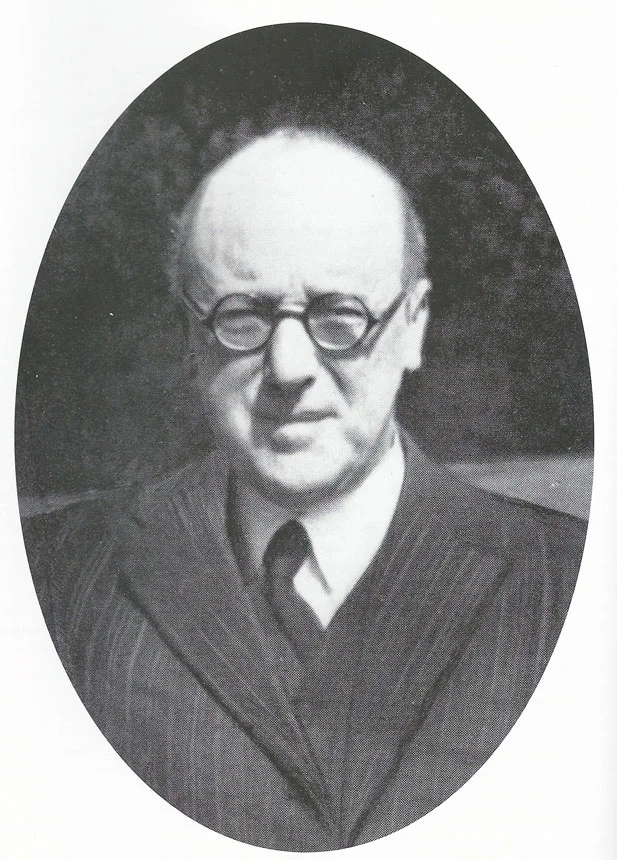
Harry Geoffrey Beasley
Over 6,000 pieces from Beasley'southward collection at present reside in five United kingdom of great britain and northern ireland museums, and many others are owned by private collectors (Waterfield & Rex, 2010).
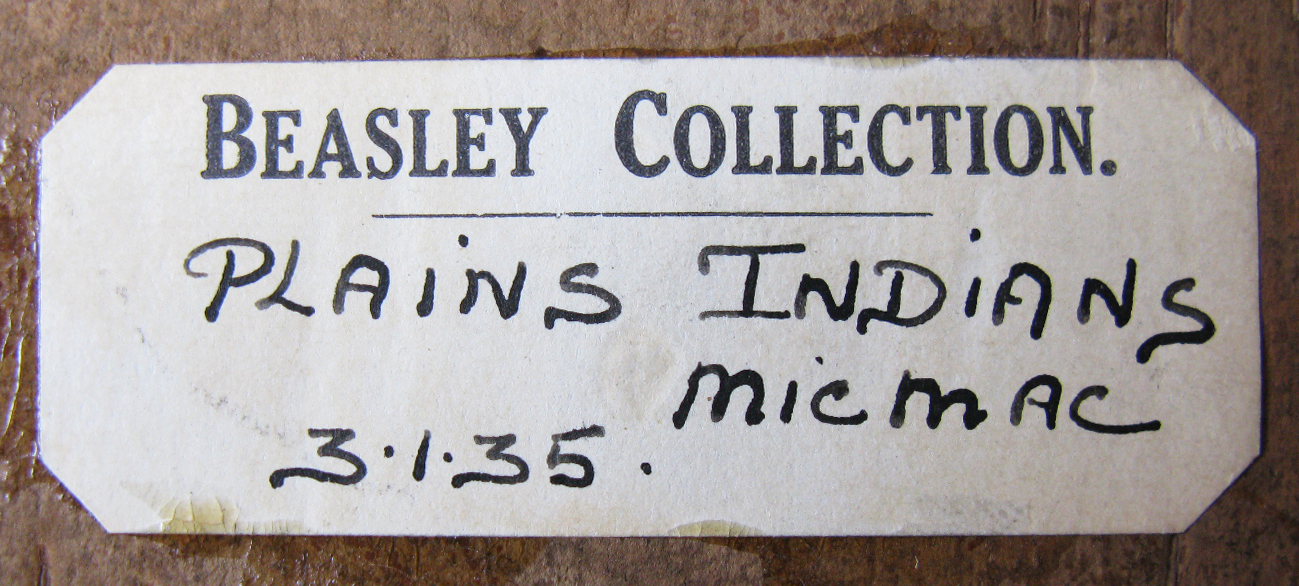
Beasley Collection label
The back of the chair seat retains the distinctive "Beasley Collection" label – a printed white ellipsoidal characterization with cut corners. Curiously, the handwritten portion of the characterization says "Plains Indians Micmac." Perchance considering Beasley's main collecting focus was on Pacific tribal textile rather than Native American fine art, he or someone working with him mistakenly associated Mi'kmaq, a Woodlands tribe, with Plains Indians. Also written on the characterization is "iii-i-35" which is the engagement in 1935 when Beasley added this chair seat to his collection.
Although Beasley sought and collected tribal material all around the globe, he might very well have obtained this piece right in his habitation country of England, given the quantities of Mi'kmaq quillwork that his countrymen had imported in earlier eras. As goes the flow of desirable antiques over the course of decades and beyond centuries, this chair seat is now bachelor back in N America to enhance a new owner's art collection or enrich their personal living space.
References
Waterfield, Hermione & J.C.H. King (2010). Provenance: Twelve Collectors of Ethnographic Art in England 1760-1990. Seattle: University of Washington Printing.
Whitehead, Ruth Holmes (1982). Micmac Quillwork. Halifax: The Nova Scotia Museum.
*Information throughout this article was derived primarily from Whitehead's exhaustively researched and profusely illustrated book, written while she was a curator at the Nova Scotia Museum.
Source: https://www.cherrygallery.com/journal-posts/mikmaq-quillwork
0 Response to "What Kind of Traditional Art Did the Mikmaq Make?"
Post a Comment